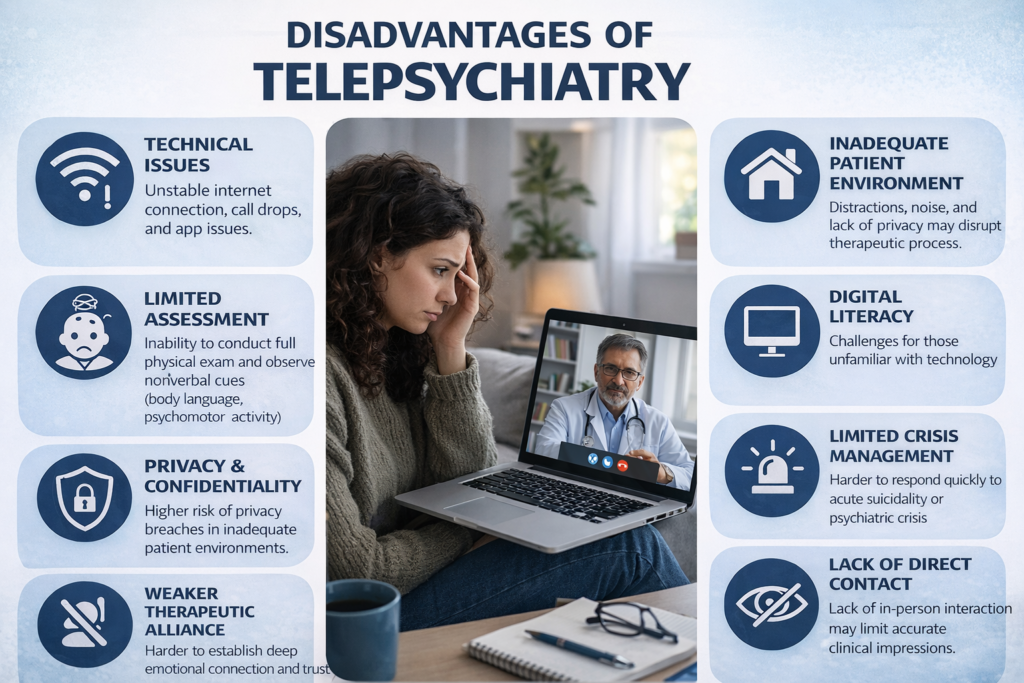
Although telepsychiatry has many advantages, it is important to also discuss its limitations and potential disadvantages. No method of treatment is perfect, and telepsychiatry is no exception. The goal is not to replace traditional psychiatry, but to complement it.
1. Technical problems
One of the most common challenges in telepsychiatry is technical difficulties such as poor internet connection, power outages, interruptions in communication, and poor audio or video quality. Such problems can interrupt a conversation at an important moment, cause frustration for both the patient and the therapist, and reduce the quality of the consultation.
2. Privacy and data security
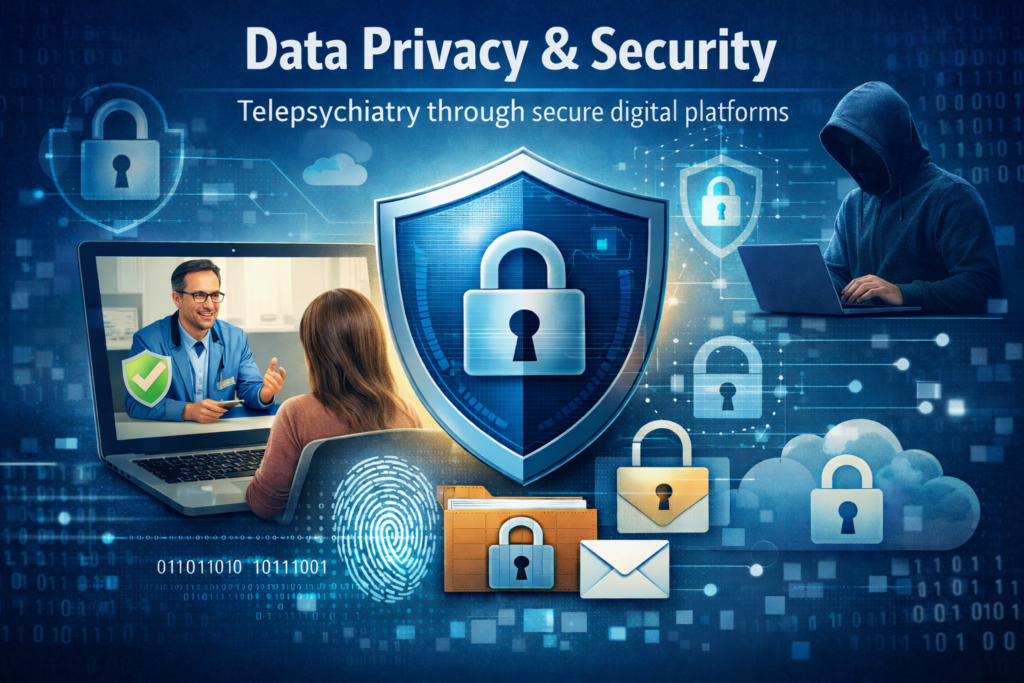
Telepsychiatry takes place through digital platforms, which raises questions about privacy protection and data security. It is important to use secure and protected platforms so that the conversation remains confidential, just as it would in a traditional office.
3. Not all patients are suitable for telepsychiatry
Telepsychiatry is not ideal for all patients. In cases of severe psychotic conditions, acute suicidal crises, severe behavioral disorders, severe addictions, or patients who do not have stable living conditions, in-person consultation is often necessary. Also, some patients simply prefer personal contact and feel safer when they are physically in the same room with the therapist.
4. Digital illiteracy and access to technology
Older individuals or people with lower socioeconomic status sometimes do not have a computer, smartphone, or sufficient knowledge to use digital platforms. In this way, telepsychiatry can create a new type of inequality – between those who have access to technology and those who do not.
5. Boundaries between private and therapeutic space
When a patient speaks from their home, it can sometimes be difficult to ensure privacy. Family members may be in another room, children may enter the room, the patient may be at work or in a car. All of this can affect openness in conversation and the therapeutic process.
6. The risk of excessive digitalization
There is also a risk that healthcare systems may start using telepsychiatry exclusively to save money rather than to improve quality of care. Telepsychiatry must not become a cheap substitute for in-person consultations, but rather an additional treatment option. If it is used only as an administrative or economic solution, it may lead to a reduction in the quality of the therapeutic relationship.
7. Nonverbal communication and limitations of video platforms
Although through video we can see the face, facial expressions, and body language, part of the nonverbal communication present in face-to-face conversations is still lost. Sometimes it is important how a patient enters the room, how they sit, how they move, and how they react to the environment. These small details can sometimes provide additional information that is harder to notice through a screen.
However, it should not be forgotten that these disadvantages mainly refer to telepsychiatry conducted via standard video platforms on computers or phones. The “gold standard” of telepsychiatry is not a simple video platform (i.e.Viber, WhatsApp, Zoom etc), but a professional videoconferencing system with a stand-alone camera that allows pan, tilt, and zoom, so that we can move closer to the patient to just a few centimeters. If we did that in a face-to-face consultation, the patient would probably feel uncomfortable and the psychiatrist might be misunderstood. In telepsychiatry, however, this can be done discreetly and without violating personal space.
In this way, we can sometimes even notice a tear in the eye, a trembling lip, or a change in facial expression earlier than when we sit one and a half meters away from the patient in a face-to-face consultation. In that sense, telepsychiatry sometimes does not reduce the amount of nonverbal information, but paradoxically may even increase it.
Therefore, the question is not whether telepsychiatry is better or worse than face-to-face consultations. The question is when it is better, when it is worse, and when it should be combined with in-person consultations.
And it is probably in this combination, in the so-called hybrid model, that the future of psychiatry lies.
Three questions for the road:
- What do you see as the biggest limitation of telepsychiatry?
- Can a therapeutic relationship be fully built through a screen?
- Should telepsychiatry replace or only complement face-to-face psychiatry?
Further Reading
- Chakrabarti S. Usefulness of telepsychiatry: A critical evaluation of videoconferencing-based approaches.
- Malhotra S, Chakrabarti S, Shah R. Telepsychiatry: Promise, potential, and challenges.
- Stoll J, Müller JA, Trachsel M. Ethical issues in online psychotherapy: A narrative review.
- Gajarawala SN, Pelkowski JN. Telehealth Benefits and Barriers.
- De Sousa A et al. Telepsychiatry and telepsychotherapy: Critical issues faced.